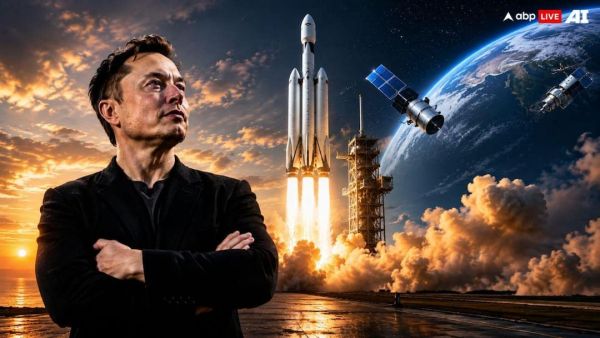
Just days after pulling off the biggest stock market debut in history, Elon Musk's SpaceX has achieved another milestone, overtaking Amazon to become the world's fifth most valuable publicly traded company.
The rally has been nothing short of remarkable.
SpaceX shares climbed for a third consecutive session on Tuesday, extending a post-listing surge that has added hundreds of billions of dollars to the company's market value. At one point during trading, the company briefly surpassed Microsoft to become the world's fourth-largest listed firm before settling back.
The move highlights the extraordinary enthusiasm surrounding Musk's space, artificial intelligence and technology ambitions, and signals that investors are increasingly willing to pay for future potential rather than present-day profits.
SpaceX Surges Past Amazon
Shares of SpaceX closed 4.8 per cent higher on Tuesday, lifting the company's market capitalisation to approximately $2.65 trillion, according to Bloomberg.
That was enough to push it ahead of Amazon.com Inc., valued at roughly $2.64 trillion.
The gains extend a stunning run that has seen the stock climb nearly 50 per cent from its IPO price of $135 per share. Shares have since surged to around $209.
The performance has helped calm concerns that the largest public listing ever might prove too large for investors to absorb.
Instead, demand has remained relentless.
The Secret Ingredient: Scarcity
Part of the rally may have little to do with rockets, artificial intelligence or even earnings.
Only around 4.2 per cent of SpaceX shares were available for public trading when the company debuted, creating an unusually tight supply of stock.
When demand surges but only a small proportion of shares can change hands, prices can move sharply higher.
That dynamic has amplified volatility and accelerated gains during the company's first few trading sessions.
Analysts note that the limited float has made SpaceX particularly sensitive to investor sentiment, with relatively small buying volumes capable of producing outsized moves in valuation.
Investors Are Buying The Future, Not The Present
Despite its eye-catching valuation, SpaceX remains far smaller than many of the technology giants it is now competing with in market value. The company generated revenue of $18.7 billion in 2025.
By comparison, Microsoft reported revenue of $281.7 billion, while Amazon generated almost $717 billion during the same period. Profitability tells a similar story.
Amazon earned $30.3 billion in profit during the first quarter of 2026 alone, while SpaceX reported a loss of $4.3 billion.
Yet investors appear focused less on what SpaceX earns today and more on what it could become tomorrow.
The company sits at the intersection of several themes currently dominating global markets: artificial intelligence, space technology, satellite internet, advanced computing infrastructure and future energy systems.
According to BBC reporting, venture capitalist Eileen Burbidge said many investors appear to be buying into a "well-marketed opportunity" centred on Musk's long-term vision rather than the company's current financial performance.
A $60 Billion AI Deal Adds To The Momentum
Fuel was added to the rally after SpaceX announced a major acquisition.
The company said it had formally agreed to acquire Cursor, the artificial intelligence coding start-up owned by Anysphere, in a transaction valuing the business at $60 billion.
Cursor has emerged as one of the fastest-growing players in the AI coding space, developing software that uses artificial intelligence to automate programming tasks.
The platform is already used by major corporations including Stripe, Adobe and Nvidia.
As part of the transaction, Cursor shareholders will receive SpaceX stock based on the start-up's implied equity valuation.
The acquisition deepens SpaceX's push into artificial intelligence as it seeks to strengthen its position against rivals such as OpenAI and Anthropic.
Retail Investors Drive The Rally
Individual investors have played a major role in the stock's explosive start.
Data from Vanda Research showed retail traders purchased as much SpaceX stock during its first two trading sessions as they bought across the entire US stock market during the previous week.
That level of participation is rare, even for high-profile technology listings.
The enthusiasm reflects growing investor interest in companies associated with Musk, whose ventures continue to attract large retail followings regardless of market conditions.
Options Trading Opens The Floodgates
Another catalyst emerged on Tuesday when options linked to SpaceX began trading on major exchanges, including Nasdaq and Cboe Global Markets.
The arrival of options often increases trading activity and can introduce additional volatility.
More than 1.6 million options contracts changed hands as traders rushed to place bets on the stock's future direction.
Market participants say the development could create further momentum through hedging activity.
When investors buy call options, market makers frequently purchase shares to offset their exposure. As the stock rises, those hedging requirements can increase, potentially creating a self-reinforcing cycle of buying pressure.
Index Inclusion Could Be The Next Trigger
Another potential boost may come from index providers.
Nasdaq recently changed its rules to allow newly listed mega-cap companies such as SpaceX to enter its benchmark indices more quickly.
Inclusion could force index-tracking funds to purchase SpaceX shares, creating additional demand.
However, S&P Dow Jones Indices has chosen not to accelerate entry requirements for newly listed firms, meaning SpaceX will not immediately qualify for inclusion in the S&P 500.
Not Everyone Is Convinced
Despite the excitement, some analysts remain cautious.
Several market observers have questioned whether the company's current valuation accurately reflects its underlying business fundamentals.
Others warn that the stock could face pressure once insider lock-up restrictions begin expiring and more shares become available for trading.
Because only a small percentage of shares currently trade publicly, any future increase in supply could dilute scarcity-driven gains.
According to wealth adviser Dan Sheehan, smaller investors risk paying a premium today for stock that could face dilution as institutional shareholders eventually sell portions of their holdings.
Elon Musk's own stake remains locked up for the first year following the listing.
Whether SpaceX can justify its valuation remains one of the most debated questions on Wall Street. What is beyond dispute is investor appetite.
The company's rise from IPO newcomer to one of the world's most valuable listed firms in just a matter of days underscores the market's growing willingness to reward ambitious long-term narratives.
For now, investors appear comfortable looking beyond revenue, profits and traditional valuation metrics.
Instead, they are placing their faith in Musk's vision of artificial intelligence, satellite networks, advanced computing infrastructure and humanity's future beyond Earth. That belief has already carried SpaceX past Amazon.
Contact to : xlf550402@gmail.com
Copyright © boyuanhulian 2020 - 2023. All Right Reserved.